Introduction to Freemasons’ Educational Series
During my research, I paid attention to international relations, the work of English and French lodges, and especially that of American lodges. My book, “A Noachite’s Dream,” uses the “desk research” method in several places. The book is based on the work of the American, French, and Hungarian lodges. There are many legends surrounding the origins of Freemasonry, and we do not know of any historical sources that would dispel all doubts. In my research, based primarily on internet sources, I examined which essential symbols of Freemasonry can be linked to the Old Testament. I only wanted to discover Old Testament connections. I did not strive for completeness but only sought the most critical points of connection. Freemason’s Educational Series
|
Who are the Noahides?Noachite, Noachida, Noahide, etc.
The Noachite form of the Hebrew Bnei Noah, Sons of Noah is intended to represent the “ch” sound, the Hebrew letter “chet,” which denotes a guttural sound. The origin of the laws known by this name can be found in the Jewish Talmud and, according to it, applies to all of humanity. The laws stipulate that all people, Jewish and non-Jewish alike, should observe them to live as “righteous people.” The term “Noachite” was known in the 21st degree of the Scottish Rite in the 18th century. As this century was the cradle of the Enlightenment, its ideas—the slogans of the French Revolution: liberty, equality, fraternity—played a symbolic role in Freemasonry. The figure of Noah became a symbol of new beginnings and moral purification. |
| Freemasonry identifies ethically and philosophically with the principles that support interfaith dialogue. A person who professes to be a Freemason is a believer in universal morality.
For Freemasons, the establishment of a universal moral system provided an ideal basis for the realization of moral universalism.
The idea of Noachida allows Freemasonry to be open to all people, regardless of nationality, religion, or social status. Such ideas also guided the Universal Declaration of Human Rights, adopted by the United Nations in 1948. This document is very similar to the “Noahide” laws, as it includes the right to human life, property, and justice. In the same declaration, we find the prohibitions Noah advocated, such as incitement to hatred, violence, and exploitation. These principles are based on global codes of ethics (e.g., AI ethics and bioethics). It supports interfaith dialogue and cultural tolerance. Freemasons revered Noah as the patron saint of their craft. |
| The Noahide laws from the Jewish religion
We know the laws of Noah from the Jewish religion: In Judaism, the Noahide laws represent seven moral laws that apply to all humanity. The term “Noachite” originated in the belief that Freemasons preserved the pure religion and traditions of Noah in a world that had strayed from them. These seven laws form the basis of Noahide thinking. According to this, every person must be capable of living a moral life, regardless of their religion.
The term “Noachide” is understood to refer to a descendant of Noah and a follower of a universal moral code. This suggests that Freemasons are bound by a fundamental moral law that transcends specific religious doctrines. The emphasis is on good and righteous people, honor, and honesty, regardless of religious affiliation, which echoes the universal nature of the Noahide laws. The essence of the Noahide idea is that there are fundamental moral laws — such as respect for life, justice, and the prohibition of theft and murder—that apply to all people, regardless of their religious or cultural background. |
| In modern Masonic lodges, the idea of Noachism appears as a symbol of the search for historical truth and as a basis for accepting religious and cultural diversity.
However, many ethical regulations are reminiscent of Noahic laws, as they protect human dignity and promote fair decision-making. (One such example is the EU AI Act.) The modern Noachita’s appears as a symbol of the search for historical truth and as a basis for accepting religious and cultural diversity. According to the symbolism of the Noachite idea, the flood symbolizes purification, and Noah represents a new beginning and moral renewal. Laws provide the basis for human coexistence. Freemasonry interprets this idea symbolically. Today, in the 21st century, religious and cultural diversity is becoming increasingly important in our thinking. The Noachite way of thinking offers a moral community to everyone, regardless of religion, by supporting dialogue among religions. In this way, it serves as an ethical compass. Today’s Noahides do not call themselves that, as their 18th-century predecessors did, but their ideology is fundamentally present in various areas of society. Such people act in the spirit of the Noahide laws. They represent humanity’s common moral mindset. For them, it is crucial to observe moral laws, protect human dignity, think ethically beyond religions, and take responsibility. Today’s Noahides are not members of a secret society, but Freemasons who care about humanity’s moral conscience. They are teachers, lawyers, developers, religious leaders, etc., essentially modern reformers. These individuals are Freemasons. They are people who want to become better human beings. |
Introduction

 The aim of my book, “A Noachite’s Dream,” is to promote understanding. I did not want to reveal secrets, but rather to explain connections. My goal was to interpret the heritage and traditions of Freemasonry.
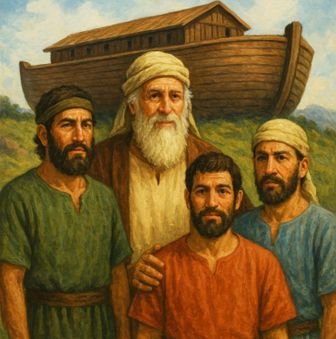 The term comes from the name Noah and has several meanings.
  See Andreson’s Constitution:
 Noah had a significant influence on the world of Freemasonry, especially in the 18th century, as Freemasons revered Noah as the patron of the craft. This designation was based on the belief that Freemasons preserved the pure religion and traditions of Noah. These Freemasons considered themselves to be the spiritual heirs of Noah.
 ORATORS.BLOG